
Tracing Former Nicholas County Owners
The current assessment owner is a fine starting point. But the newest recorded deed is the real first link in the chain. That deed names the grantor who just let go of the parcel. From there, each transfer adds another rung. For every deed you touch, note the date, grantor, grantee, and deed type. Also note the legal description and the book and page citation. Treat the table as a blank field plan rather than a worked example. No sample Nicholas County deed result appears on the page. Inventing a name or recording date would mislead you.
| Transfer Date | Grantor to Grantee | Deed Type | Book and Page |
|---|---|---|---|
| Most recent conveyance date | Prior grantor to current grantee | Use the portal's actual deed label | Copy the reference shown in the index |
| Prior acquisition date | Earlier grantor to the prior owner | Check deed, corrective, partition, or other relevant type | Follow the earlier book and page |
| Older book reference | Continue party-to-party backward | Confirm in the Clerk's volume or index | Ask which book, rack, scan, or copy holds it |
Online deed records can open the route. The County Clerk publishes no cutover year or year runs for each book, though. Fill the table from the parcel's actual result, never from a guessed date range.
Walking the Nicholas County Deed Chain
West Virginia recording law indexes every deed two ways, by grantee and by grantor. That structure is the engine of a backward search. You move from the current grantee to the prior owner. Then ask how that earlier party acquired the parcel in the first place. Run names through the Clerk index with the date range, party role, document category, and book selectors. Use one selector at a time. The latest assessment owner can suggest where to begin. The tax roll can lag a newer deed, so confirm against the deed records themselves.
- Search the current owner as GRANTEE and locate the newest deed tied to the parcel.
- Read the deed's grantor and compare its legal description with the property.
- Search that grantor as GRANTEE to find the prior acquisition.
- Repeat until the portal no longer returns the needed book, then ask the Clerk for its older index route.
- Grantor / grantee
- The party transferring an interest and the party receiving it.
- Chain of title
- The ordered series of conveyance records for a parcel.
- Legal description
- The deed's land description, which may remain useful when street names change.
The Nicholas County Clerk index provides the party-role and book selectors this backward search depends on.
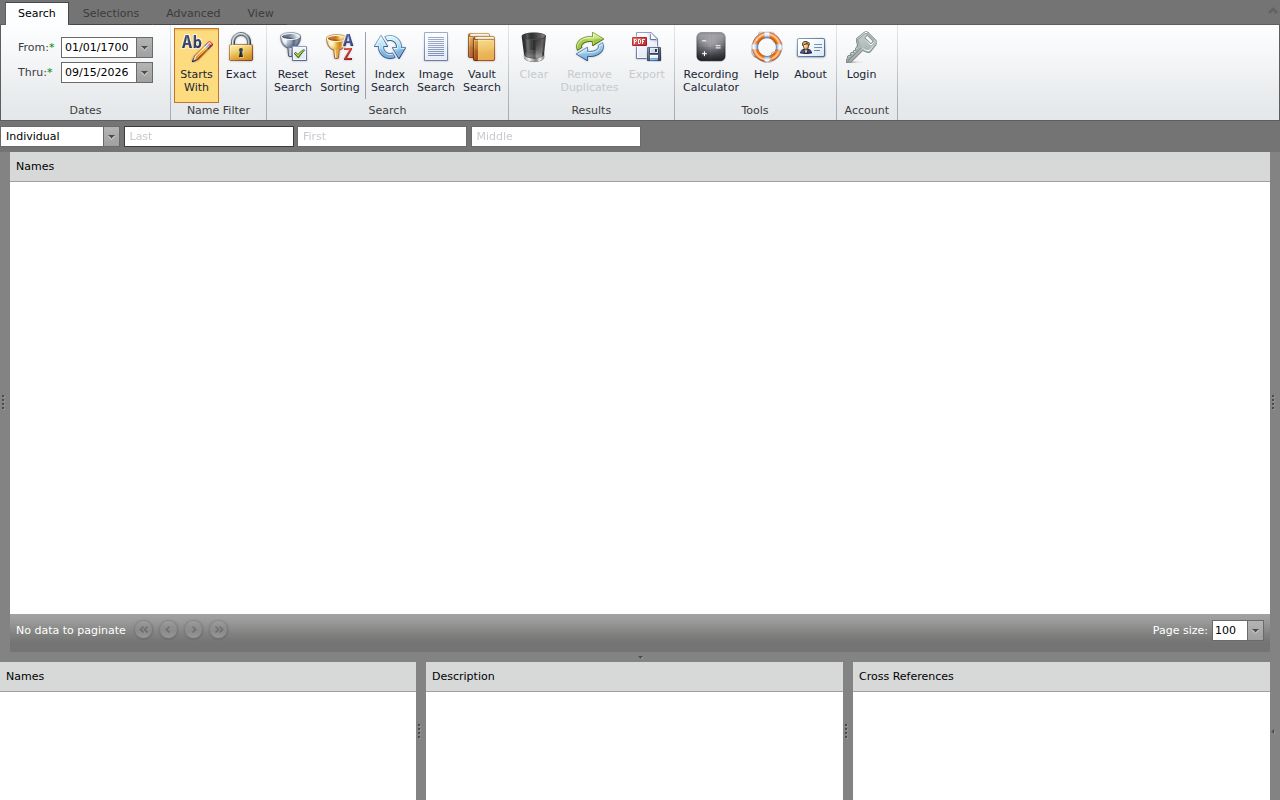
Search under both party roles, and keep every book and page citation as the trail moves backward.
Nicholas County Index Coverage Gap
The public County Clerk page confirms that recorded-document indexing is online. But it says nothing about the year the web index begins or when images start. The portal's date controls will accept old dates. Accepting a date is not proof that every record from that era is indexed. The county publishes no exact imaging cutover. It lists no online start year. It posts no subscription or image fee schedule. When the trail stops, write down the oldest deed type, date, book, page, and party name you have. Ask the Clerk to check the older grantor and grantee index. Also ask the office to identify whether a bound book, map rack, scan, or other format survives. Avoid asserting any cutoff year until the office confirms one. See the Nicholas County Clerk page for the local record custodian.
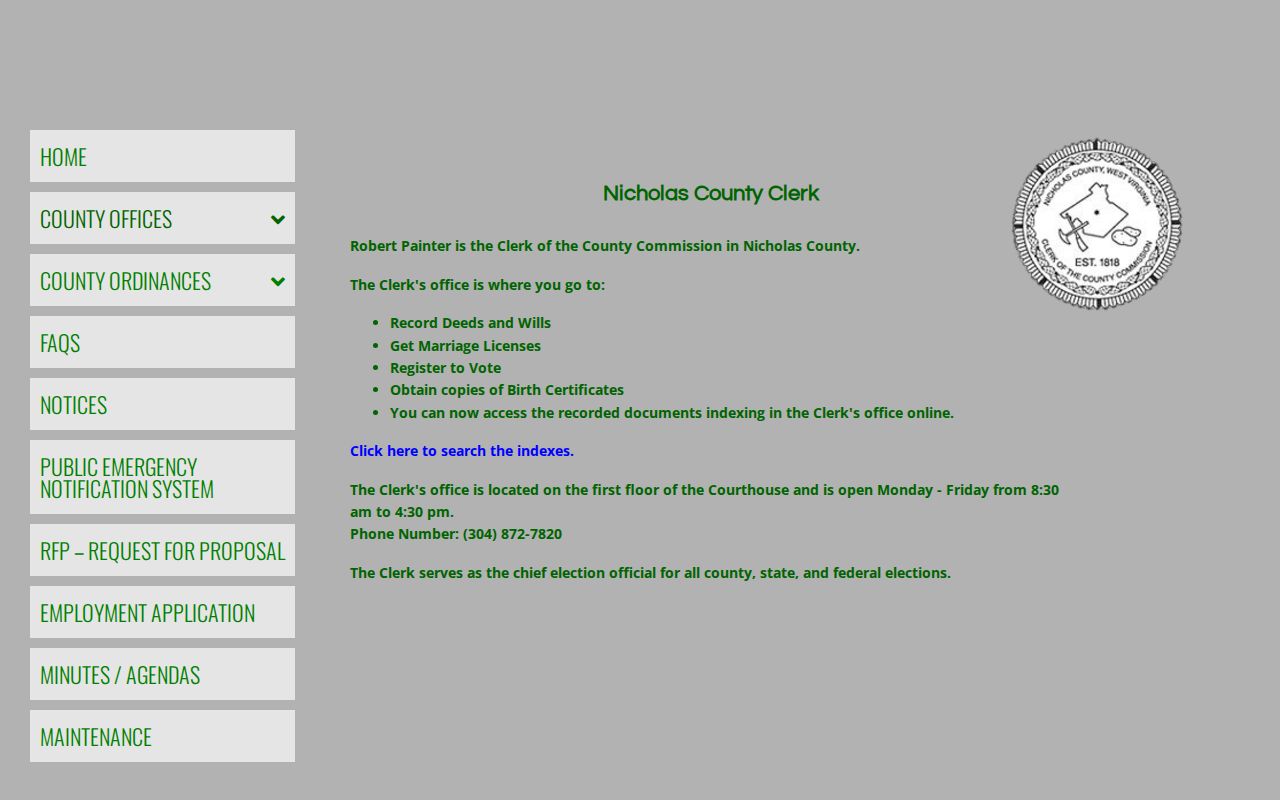
When the online chain stops, the County Clerk can point you to the older index or book series to consult.
Nicholas County Courthouse History
Nicholas County was founded in 1818. Summersville served as the county seat by around 1820. The present stone courthouse rose in 1898 after an earlier frame building. A major Civil War-era fire destroyed much of the town. That history hints at what a house-history search might face. The sources do not identify which property books or images were lost. Prove an owner chain with index and deed references, never by inference from the fire. For early transfers, request the older grantor and grantee index. Compare the legal description against today's district, map, and parcel fields. If a deed is missing from the online result, ask the Clerk to check the bound series and any copies before declaring a gap.
Nicholas County Estate Transfers
A prior owner's death can move a parcel by will. It can also move through a probate order, a fiduciary appointment, an executor or administrator deed, a trust, an affidavit, or a later deed from the heirs. The Clerk index carries Estates, Estate Claims, Fiduciaries, Final Account, Final Order, Wills, and Will and Codicil. Related historical categories appear as well. Search the name as a party too. A deed trail often shifts after a death. A probate order explains who had authority; it is not itself the conveyance. Compare the recorded deed or distribution instrument against the assessment roll. The state Vital Registration office issues certified death certificates. A certificate gives a date lead, not a title record. For current certificate rules and the fee, use the West Virginia Vital Registration request instructions.

Use a vital record only for a life-event clue. The deed, will, or court instrument supplies the actual land-transfer evidence.
Nicholas County Old Description Clues
Older deeds often lead with district, map, parcel, or tract wording. They rarely give a modern street. Nicholas County's historical districts include Beaver, Grant, Hamilton, Jefferson, Kentucky, and Summersville; Wilderness also appears in census-era county geography. Pair those names with a grantor or grantee search when a road lookup fails. Confirm the district and map key from the parcel record itself. Do not rely on a town name. Richrich searches may also need earlier names tied to Cherry Tree Bottoms, timber-company holdings, river forks, mills, or railroad tracts. Summersville's county-seat and post-fire eras offer a different set of clues. All of them can steer a query. None of them proves ownership on its own.
Nicholas County Plat and Deed Books
Nicholas County plat research starts with two Clerk categories: Map Book and Map Rack. A plat often shows how an older parent tract split into named lots. A partition deed can tie that map to an actual conveyance. Search the Clerk's deed records under the current owner and each prior owner. Note the book and page for every transfer you find.
No map-book year run or subdivision catalog is published online. Ask the Clerk whether an old volume survives as a bound book, microfilm, or scan. Local libraries, the state archives, and FamilySearch are reasonable fallback leads. They can help with older plats and deeds. None confirms an exact Nicholas County collection or year range.
How Far Back Nicholas County Ownership Records Go
Nicholas County publishes no firm start year for its deed books. Nor does it give one for its historic plats or tax rolls. The chain of title is real, though. It simply lives in places you have to ask about. FamilySearch holds possible leads for old Nicholas County property records. So do the West Virginia State Archives, local libraries, and the county historical and genealogical society. Start with the County Clerk. Ask for the oldest book reference in your parcel's chain. Then match that title and date against a library or archive catalog.
Old descriptions rarely read like modern addresses. A district name may stand in for a street. So may a timber tract, a river fork, or an earlier town name. In Richwood, watch for the Cherry River forks and Cherry Tree Bottoms. Watch for timber, mill, or railroad language too. Those terms frame a deed search well. In Summersville, courthouse and post-fire dates give useful local context. Even so, they prove nothing about any single volume.
Coverage limit. The County Clerk has not published the earliest online index year or image cutover. Ask which older deed book, map rack, bound volume, scan, or microfilm record covers the reference before assuming the web result is complete.
Prior-owner details from Nicholas County property records suit property history, title work, estate matters, and due diligence. Never use them to track, threaten, or harass a living person.